
Top Signs You Need Air Duct Cleaning Service – Don’t Ignore These
Dust blowing out of your vents isn’t the first sign your ducts need cleaning. It’s usually the last one before the problem gets expensive. In our experience across Southeast Raleigh, the earliest signals are quieter: a filter that clogs faster than it used to, one bedroom that never quite matches the thermostat, a power bill that creeps up while your habits stay the same. By the time you see dust at the register or catch a musty smell, contamination has been building for months. If you’d rather not guess, call (866) 937-7160 for a free estimate.
Why Dust at the Registers Is the Last Sign, Not the First
Most homeowners start looking for duct cleaning when they can see the problem. That’s backwards. A forced-air system moves hundreds of cubic feet of air per minute, and the return side pulls in whatever’s floating around your home along with it. Particulates settle on duct walls in layers over time. The supply registers are the tail end of that system, so visible dust there means the buildup upstream already has enough mass to shed particles into the airstream every time the blower runs.
Think of it like a gutter. You don’t notice the leaves until water starts spilling over the edge, but the clog started weeks earlier. Ducts behave the same way.
We reorder the warning signs below by how early they appear, not by how dramatic they look. Early-stage signals give you room to plan. Late-stage signals mean the debris load is high enough that it’s affecting your air and your system at the same time.
One thing worth saying up front: some of these signs mean a cleaning will solve the problem outright. Others point to a physical defect in the ductwork itself, and cleaning alone won’t fix those. We flag the difference as we go.
Early Signs Most Southeast Raleigh Homeowners Miss
These are the quiet ones. None of them look like a duct problem on the surface, which is exactly why they get ignored for months.
- Your filter loads faster than usual. If a filter that used to last three months is gray by week five, that material is coming from somewhere. A dirty duct system keeps recirculating debris, so the filter is doing double duty. Compare the filter face to the last one you pulled out. A noticeably darker or heavier load with no other explanation is a reliable early tell.
- Energy bills rise without a usage change. Restricted airflow makes the blower work longer to push the same volume of conditioned air. You haven’t changed the thermostat, the weather has maybe shifted a little, but the bill moves in a way that doesn’t track. Check the last two cycles against the same months a year earlier before you blame the rate plan.
- One or two rooms never match the rest. Uneven temperatures can come from balancing issues, but when a room runs warm in summer and cool in winter while the rest of the house holds steady, restricted flow through that branch is a common cause. Debris accumulates unevenly, especially on longer runs or runs with more bends.
- The system sounds slightly different. A strained blower, a whistle at the register, more noise than you remember. Airflow restriction changes the sound profile of the whole system.
None of these prove your ducts are dirty. Together they’re a strong reason to get the system looked at before the problem moves to the next stage.
Mid-Stage Signs: When Your HVAC Is Clearly Involved
Mid-stage signals tie directly to the system running. That’s the giveaway. A smell in the basement might be anything. A smell that appears only when the blower kicks on is coming from inside the ductwork.
Odors that follow the HVAC cycle
When air moves through a contaminated duct, it picks up whatever’s growing or settled on the interior surfaces. Musty, stale, or vaguely dirty sock smells that show up a minute or two after the system starts and fade after it stops are the classic mid-stage indicator. Pay attention to timing. Odor that’s constant throughout the house points elsewhere. Odor that comes and goes with the blower points at the ducts.
Allergy symptoms that track HVAC operation
Seasonal allergies follow pollen counts. If symptoms instead track how much the system is running, that’s a different pattern. People in Southeast Raleigh tend to notice this in the shoulder seasons, when the HVAC cycles on and off more unpredictably. Symptoms that worsen indoors during heavy cooling or heating stretches, and ease when the system sits idle, suggest the air handler is distributing irritants rather than clearing them.
Visible dust settling faster in specific rooms
If the furniture in one room needs dusting twice as often as the rest of the house, that room’s supply run is likely shedding more than the others. It’s also a signal that the return-side draw on that part of the system is unbalanced.
Mid-stage is the sweet spot for a cleaning. The contamination is real but hasn’t yet forced the system into the efficiency and air quality problems that come at the late stage.
Late-Stage Signals That Point Beyond Plain Dirt
This is where the conversation changes. Late-stage evidence often means you’re not just looking at accumulated dust. You’re looking at a moisture problem, a pest intrusion, or a defect in the ductwork itself.
What to watch for:
- Dark streaking or spotting near the registers or inside the boot. Discoloration that isn’t uniform dust but clustered, patchy, or grows over time suggests biological growth, which needs moisture and needs a source fix, not just a scrub.
- A persistent damp or earthy smell that doesn’t clear. Different from a musty HVAC odor: heavier and continuous. This often points to condensation in the system or humidity migration into duct runs.
- Pest evidence. Droppings, shredded material, or consistent scratching sounds in the duct chases. Rodents and insects use duct chases as highways. Cleaning removes the debris, but the entry point has to be sealed or they come right back.
- Visible gaps, disconnected joints, or torn flexible duct. If you can see a duct junction that’s come apart in the attic or crawlspace, you’re losing conditioned air into that space and pulling unfiltered air in. No amount of cleaning fixes that. It needs repair and sealing.
- Repeated headaches, throat irritation, or respiratory complaints that improve away from home. This is the point where a professional inspection matters more than speculation. Have the system evaluated rather than hoping it resolves.
Late-stage does not always mean mold. It means the evidence has crossed from “dirt” into “possible source cause,” and those two things get different solutions.
How Southeast Raleigh Humidity Changes What You’ll Notice
This is the part that makes local judgment matter. Southeast Raleigh sits in a humid subtropical climate with long, muggy summers. That’s not a footnote. It reshapes which symptoms show up and when.
Condensation is the mechanism. When humid air meets a cool surface inside the duct system, moisture forms. In a dry climate, that rarely happens with meaningful volume. Here, with summer humidity running high for weeks, the interior of an air-conditioned duct system is a condensing surface much of the season. That moisture is what biological growth needs.
What this means in practice:
- Musty odors linked to air conditioning are more common here than in drier areas.
- Mold-related spotting tends to cluster where duct runs pass through unconditioned attics and crawlspaces, where temperature differentials are sharpest.
- The window between “early” and “late” can compress in a humid summer, so mid-stage signs deserve more urgency here than they might elsewhere.
- High-efficiency filtration and moisture-aware equipment matter more than raw cleaning power alone. This is why our work uses Abatement Technologies negative-air and HEPA filtration tools to capture what’s dislodged rather than redistribute it, and why air quality and sanitizing treatments belong in the same visit as the cleaning.
If you’re seeing mold-type indicators, get the system evaluated by someone who specializes in forced-air ductwork. A general handyman can’t assess it properly, and cleaning alone won’t solve a moisture source.
Cleaning Sign vs. Repair Sign: How to Tell Them Apart
This is the most useful distinction in the whole article. A dirty duct needs cleaning. A functioning problem needs repair. Some homes need both, and it pays to know which one you’re dealing with.
| Sign | What it usually means | What solves it |
|---|---|---|
| Filter loads quickly, uneven room temps | Accumulated debris, restricted airflow | Cleaning typically resolves |
| Musty odor only when HVAC runs | Biological growth on duct surfaces | Cleaning plus sanitizing, moisture check |
| Visible gaps, disconnected joints | Air loss, unfiltered air drawn in | Repair and sealing, then verify airflow |
| Pest droppings or shredded material | Entry point exists | Cleaning, then sealing entry point |
| Dark spotting that grows over time | Moisture source feeding growth | Source fix plus remediation-grade cleaning |
The mistake we see most often is a cleaning done on a system with a physical defect. The ducts get clean, then immediately re-contaminate because the gap or moisture source was never addressed. Repair and sealing are core work for us for exactly this reason. Cleaning and sealing should be evaluated together, in one visit.
When to Call a Pro Instead of Peeking Inside Yourself
Opening a register cover and looking is fine. Reaching into duct runs is not. Duct interiors hold sharp sheet metal edges, flexible duct wire, and in humid climates, biological growth you don’t want to disturb in a way that aerosolizes it through the house. If you suspect a moisture problem, a pest issue, or mold-type growth, stop there and call.
To answer the question before it comes up: yes, there are things you can check safely. Change your filter and look at what came out. Note which rooms run hot and cold. Time the odors against the HVAC cycle. That’s a fair picture to give a technician, and it helps the inspection move faster.
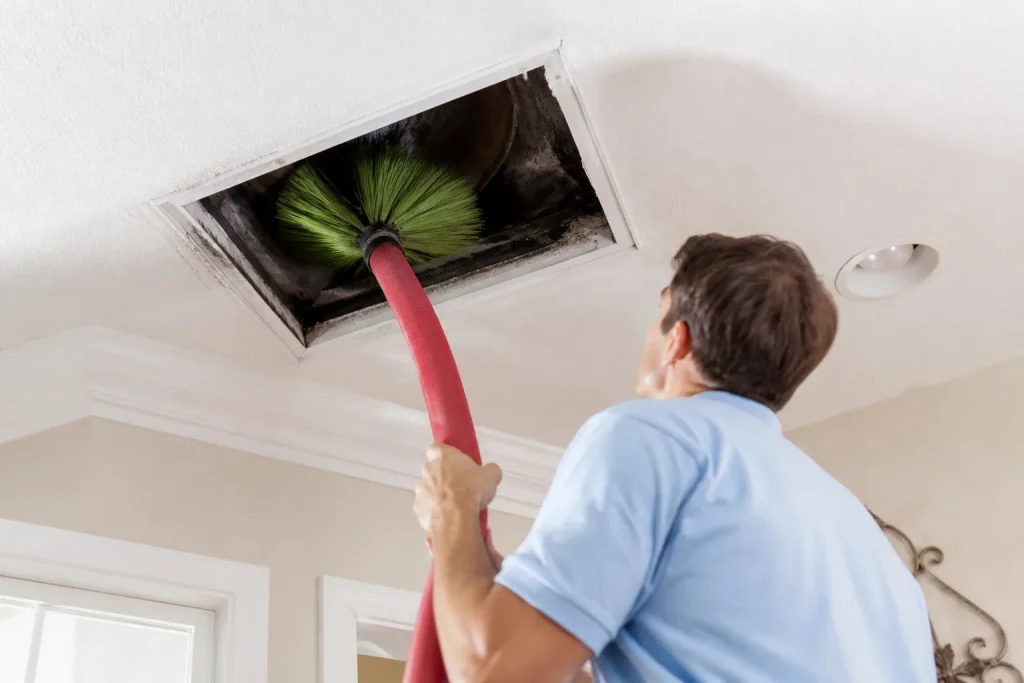
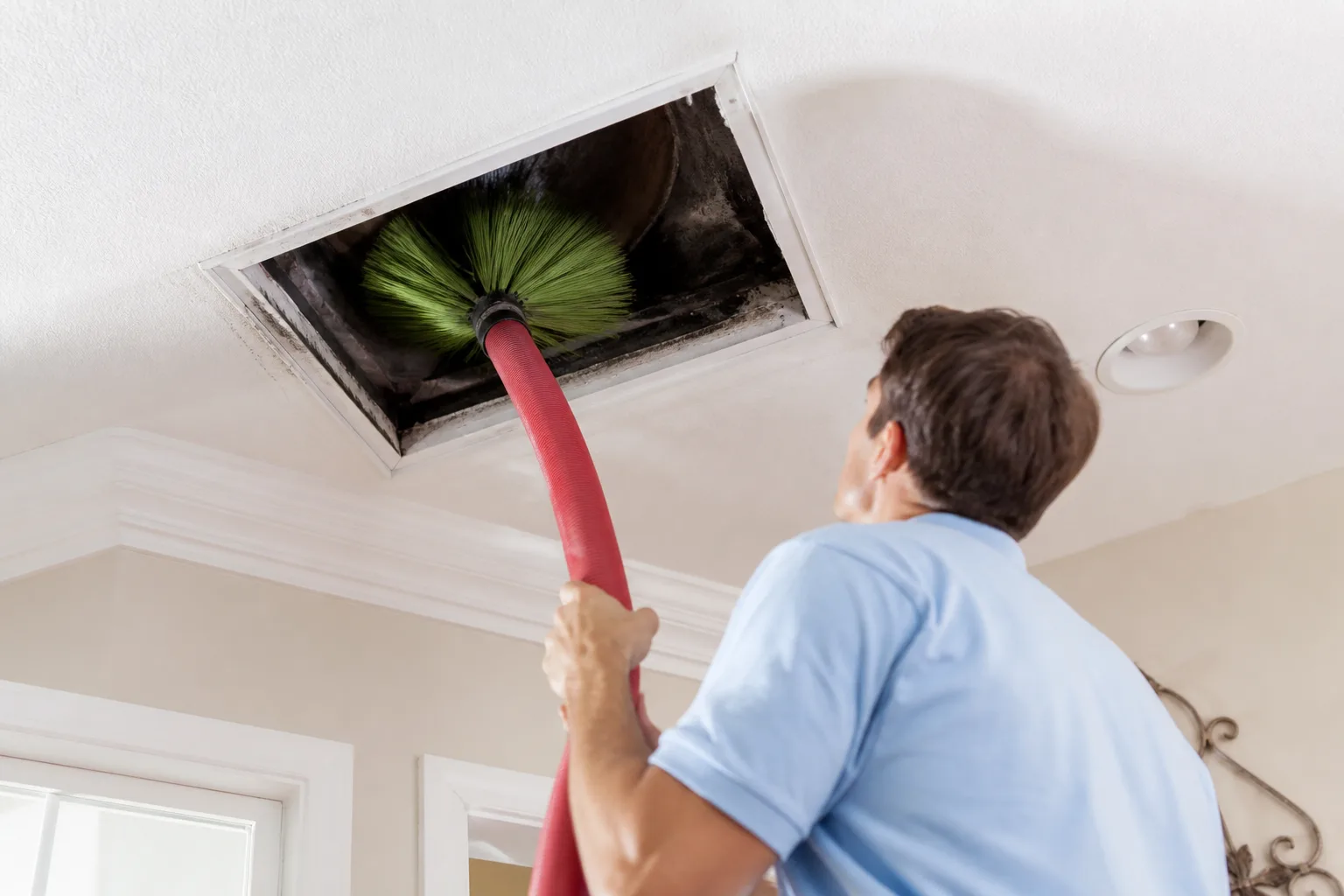
The inspection itself is where the real answer lives. Professional-grade equipment, not a shop vac, is what actually cleans a duct system. We use Rotobrush and Nikro systems, and we work from the inside out with containment so the debris leaves the system rather than landing in your living room.
Related services in Southeast Raleigh: if your signs include a dusty filter and a creaking dryer that takes two cycles to finish, dryer vent cleaning covers the lint side, which is a fire-risk step that many duct services skip. If the whole system has been running hard for years without attention, HVAC cleaning addresses the air handler and coil side, not just the ducts.
The Bottom Line
The signs most people notice last are the ones they should notice first. Early signals, like fast-loading filters, rising bills, and uneven room temperatures, give you room to plan. Mid-stage signals, like musty odors tied to the HVAC cycle and allergy patterns that follow the system, mean the contamination is real and affecting air quality now. Late-stage signals, like spotting, persistent damp smells, pest evidence, or visible gaps, mean cleaning alone won’t be enough and repair and sealing belong in the plan.
Southeast Raleigh’s humid summers tighten that timeline. What might be a slow climb in a dry climate can move faster here.
The full-system approach matters because these categories overlap. Cleaning, air quality treatments, and duct repair under one roof means one visit addresses the whole forced-air system instead of three separate visits that each find something the others didn’t. If you’re in Southeast Raleigh and need help, Air Duct Cleaning Southeast Raleigh offers free estimates. Call (866) 937-7160. We answer 24/7. Fast dispatch from 7am to 7pm, Sunday through Friday.
Frequently Asked Questions
Most homes do well with a cleaning every three to five years, but Southeast Raleigh’s humidity and the presence of pets, recent renovations, or an older system can shorten that. Rather than going by the calendar, watch for the early signs: a filter that clogs faster than it should, uneven room temperatures, and odors tied to the HVAC cycle. If those show up sooner than the calendar says, the ducts need attention. Call (866) 937-7160 for an exact schedule recommendation. Estimates are free.
Yes. Restricted airflow forces the blower to run longer to move the same volume of air, and that shows up on your bill. It’s one of the early signs precisely because it appears before anything visible does. If your usage hasn’t changed but the bill has, compare the last two cycles against the same months last year before you blame the rate plan. Call (866) 937-7160 for a system check. Estimates are free.
Not necessarily, but it’s a mid-stage sign worth taking seriously. Odor that appears shortly after the blower starts and fades after it stops points to something on the duct surfaces, and in a humid climate that often means biological growth fed by condensation. It needs an inspection, not a guess. If the smell is continuous and damp rather than cycle-linked, the priority is finding the moisture source. Call (866) 937-7160. We answer 24/7. Fast dispatch from 7am to 7pm, Sunday through Friday.
No. Cleaning removes contamination, but it doesn’t restore a gap, a disconnected joint, or a moisture source. Clean ducts will re-contaminate quickly if the underlying defect is left in place, which is why we assess repair and sealing in the same visit as the cleaning. The useful split is this: dirt signs point to cleaning, structural signs point to repair. Most homes need a clear answer on both. Call (866) 937-7160 for a free estimate.
Yes, it’s worth a look. A single room that runs warm in summer and cool in winter while the rest of the house holds steady usually means airflow through that branch is restricted. Debris settles in uneven layers, and longer or more winding runs tend to collect more than short ones. It’s an early sign, so it’s the right time to get the system evaluated before it becomes a bigger problem. Call (866) 937-7160 for a free estimate.
You can safely remove a register cover and look in, and you can check your filter and note the room temperatures. But don’t reach into duct runs. Sheet metal edges, wire, and possible biological growth require proper containment and professional-grade equipment to handle safely. The best route is to relay what you observed so the technician knows where to focus. Call (866) 937-7160. We answer 24/7.
About This Page
Air Duct Cleaning Southeast Raleigh specializes exclusively in forced-air system services: air duct cleaning, dryer vent cleaning, HVAC cleaning, air quality and sanitizing treatments, and duct repair and sealing. Our technicians have up to 13 years of experience. We work with professional-grade equipment from Rotobrush and Nikro, containment and HEPA filtration from Abatement Technologies, and air quality components compatible with Honeywell and Aprilaire systems already in many homes. You can also reach our main hub at Air Duct Cleaning Southeast Raleigh or read more about air duct cleaning if you want the full service rundown.
Call (866) 937-7160 for a free estimate. We answer 24/7. Fast dispatch from 7am to 7pm, Sunday through Friday. Closed Saturday.
Written by the team at Air Duct Cleaning Southeast Raleigh.
Need Air Duct Cleaning Help?
Call Air Duct Cleaning Southeast Raleigh - the local pro we connect you with is licensed and insured, here with fast help in Southeast Raleigh.
(866) 937-7160